

Week 29: 07/13–07/19/2026
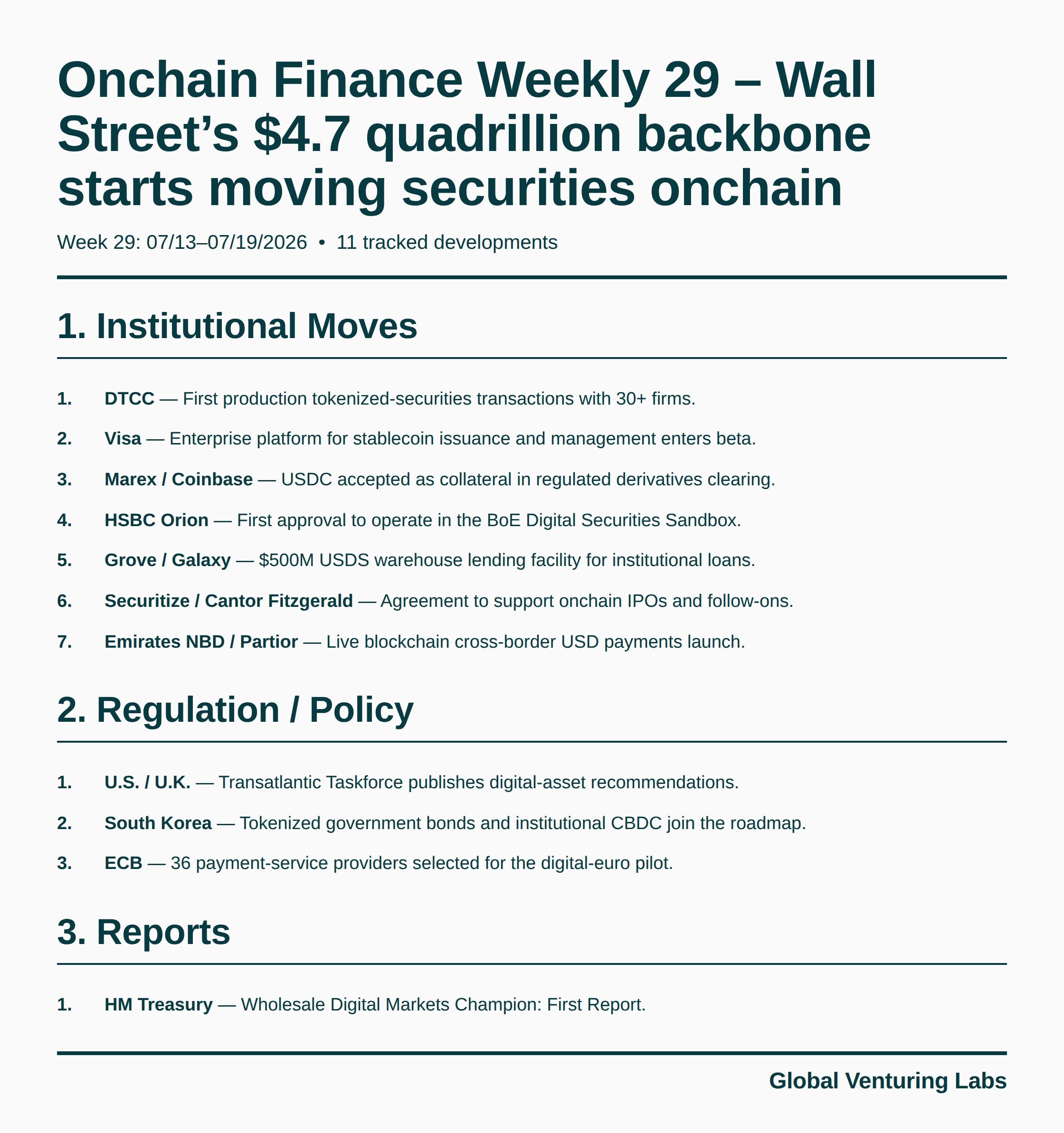
This week, 7 institutional moves, 3 policy updates and 1 major publication were tracked across tokenized securities, stablecoin operations, derivatives collateral, digital depositories, institutional credit and cross-border payments.
The Signal:
Tokenization reached the transaction layer this week.
DTCC used tokenized securities in real production trades. Marex accepted USDC within a regulated derivatives-margin workflow. Emirates NBD launched live blockchain-based dollar payments through Partior. These developments place onchain infrastructure inside three core financial functions: processing securities, delivering collateral and settling cash.
1. Key Takeaways
DTCC established a production benchmark. The infrastructure group that processed $4.7 quadrillion of securities transactions in 2025 converted DTC-held assets into tokens and used them in production trades with more than 30 participating firms.
Stablecoins moved deeper into financial operations. Visa introduced enterprise issuance and management infrastructure, Marex accepted USDC as derivatives collateral, and Grove committed USDS capacity to a $500 million Galaxy lending facility.
Primary issuance is becoming the next target. HSBC Orion was approved to operate in the Bank of England’s sandbox, Securitize and Cantor are preparing a pathway for onchain public offerings, and South Korea placed tokenized government bonds on its 2027 roadmap.
2. The Weekly Breakdown
2.1 Institutional Moves
DTCC uses tokenized securities in real production trades
DTCC converted securities held at The Depository Trust Company into tokens and used them in production trades covering U.S. Treasuries, repo, equities, securities lending, collateral pledges and central-counterparty margin. More than 30 firms participated, including BlackRock, Goldman Sachs, JPMorgan, State Street, Vanguard, CME Group, Nasdaq, the New York Stock Exchange and Tradeweb. The transactions preceded the planned October launch of DTCC’s Tokenization Service and represent a material test by an organization that processed $4.7 quadrillion of securities transactions and serviced $114 trillion of assets in 2025.
Visa introduces an enterprise platform for stablecoin issuance and management
Visa introduced a platform through which financial institutions can configure, mint, distribute, transfer, manage and redeem stablecoins. The platform has entered beta testing with selected clients, initially supporting OpenTrade’s OUSD, and extends Visa’s role from stablecoin-funded payments and settlement into the operating lifecycle of institution-issued digital money. Visa has not disclosed client numbers, transaction volumes or a broader launch timetable.
Marex and Coinbase bring USDC into regulated derivatives-margin workflows
Marex completed its first transaction accepting USDC as collateral within a regulated derivatives-clearing workflow, with Prime Trading as the first client and Coinbase providing custody, conversion and reporting. The transaction shows that USDC can be incorporated into a margin process with institutional requirements for valuation, segregation and reporting, although repeat transactions and additional clearing clients are still needed to demonstrate scale.
HSBC Orion receives approval to operate in the Bank of England’s Digital Securities Sandbox
HSBC became the first applicant approved to operate a digital securities depository within the Bank of England and Financial Conduct Authority’s Digital Securities Sandbox. Orion is expected to support the UK government’s Digital Gilt Instrument pilot by the first quarter of 2027 and is being connected with LSEG infrastructure. The approval begins assembling the regulated market structure for a digitally native UK government bond, although DIGIT has not yet been issued.
Grove and Galaxy establish a $500 million institutional lending facility
Grove and Galaxy established a $500 million warehouse facility for institutional loans secured by bitcoin and ether, including certain forms of staked ETH. Grove will provide USDS-denominated financing through a dedicated vehicle, while Galaxy will originate, underwrite and service the loans. Collateral will be held with Anchorage Digital or BitGo and subject to concentration limits and continuous loan-to-value monitoring. The $500 million represents available facility capacity rather than loans already deployed.
Securitize and Cantor Fitzgerald agree to support onchain IPOs and follow-on offerings
Securitize and Cantor Fitzgerald agreed to create a pathway for companies to conduct IPOs and follow-on offerings using blockchain-based securities infrastructure. Cantor will contribute its equity-capital-markets and trading capabilities, while Securitize will provide issuance, distribution, servicing and regulated broker-dealer infrastructure. The structure would bring tokenization into primary public-market fundraising, but no issuer or transaction has yet been announced.
Emirates NBD launches live blockchain-based cross-border payments through Partior
Emirates NBD launched real-time cross-border U.S.-dollar payments for corporate and institutional clients through Partior’s blockchain-based clearing and settlement network. JPMorgan acted as both the settlement and beneficiary bank in the first live transaction, and eligible Emirates NBD clients can now use the service for payments to beneficiaries holding JPMorgan accounts. The initial corridor remains narrow, with additional currencies, banks and markets planned as the network expands.
2.2 Regulation and Policy
The taskforce published recommendations covering digital-asset regulation, tokenized markets, cross-border market access and regulatory cooperation. A separate joint statement on stablecoins outlines shared principles for issuer supervision, reserve protection, redemption and financial stability. The documents do not create binding requirements but establish a basis for making the two jurisdictions’ stablecoin and digital-asset regimes more compatible.
South Korea’s economic strategy includes a 2027 pilot connecting tokenized government bonds with the Bank of Korea’s institutional CBDC infrastructure. The program would test digitally issued sovereign debt alongside central-bank settlement, placing both the security and payment legs within one public-sector initiative. The market is not yet operational, but tokenized government debt is now part of the country’s formal implementation roadmap.
ECB selects 36 payment-service providers for the digital-euro pilot
The European Central Bank selected 36 payment-service providers for a 12-month digital-euro pilot expected to begin in the second half of 2027. Participants will test payment use cases, technical integration and operating processes using a pilot currency that will not constitute legal tender. The selection moves the project into external preparation with banks and payment companies, although operational testing remains more than a year away.
2.3 Notable Publications
HM Treasury — Wholesale Digital Markets Champion: First Report
HM Treasury’s 71-page report sets out a coordinated program for modernizing UK wholesale markets across digital securities, fund tokenization, collateral mobility, settlement, interoperability and regulatory treatment. It establishes nine industry taskforces to convert these priorities into implementation plans, giving the UK a formal delivery structure for wholesale digital markets. Its impact will depend on the changes produced by those taskforces and their adoption by market participants.
3. Closing
This week mattered because onchain infrastructure handled real securities, collateral and payments inside regulated financial workflows.
DTCC provided the clearest evidence at market-infrastructure scale, while Marex and Emirates NBD demonstrated narrower but live applications. Visa, HSBC and Securitize are building the next layer, although their significance still depends on production use.
The next measure of progress is straightforward: recurring volume, repeat participants and capital actually deployed.